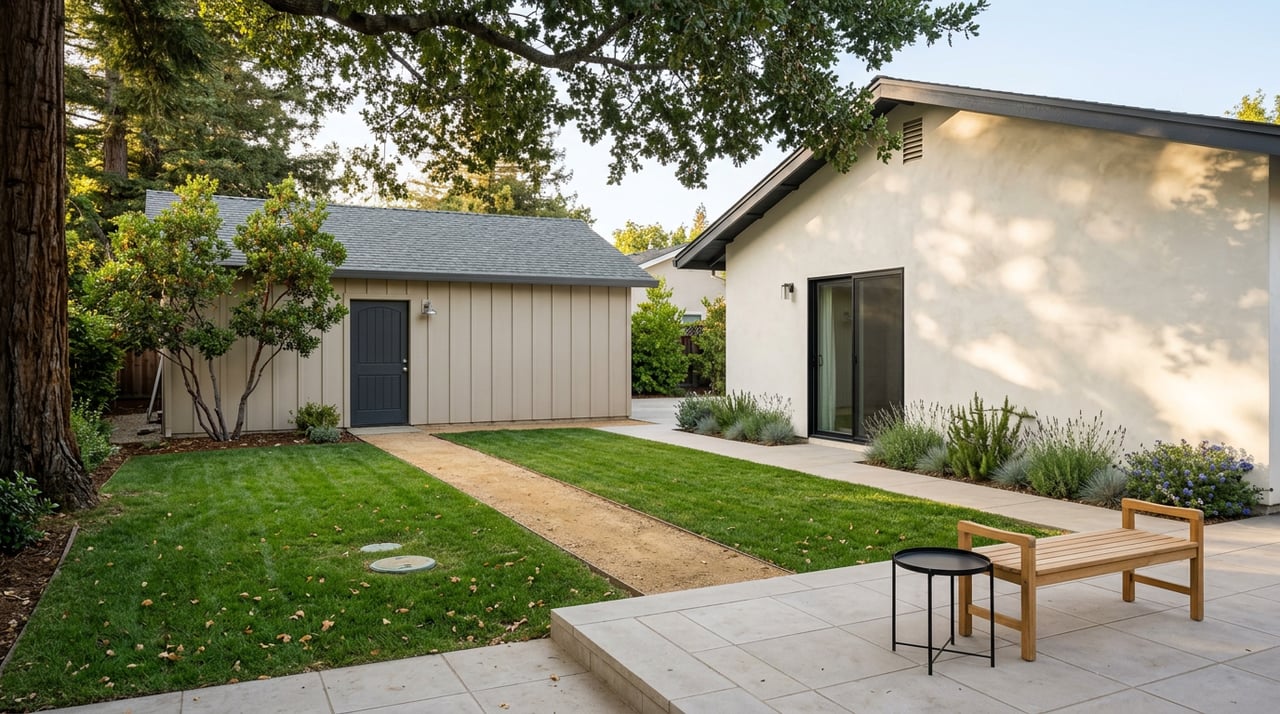
Your Guide to Cotati CA ADU Guidelines & Potential
March 24, 2026
March 24, 2026
Thinking about adding a backyard cottage, rental studio, or extra suite to your Cotati property? You are not alone. ADUs are popular across Sonoma County for flexible living, long-term rental income, and multigenerational space. In this guide, you will learn the key Cotati rules, what to check on your lot, typical timelines and costs, and the next steps to move forward with confidence. Let’s dive in.
An Accessory Dwelling Unit is a self-contained secondary home on the same parcel as your primary residence. A Junior ADU, or JADU, is a small unit within your existing home with an efficiency kitchen and a maximum size of 500 square feet. For a clear state overview, review the California ADU resources from the Department of Housing and Community Development. You will find definitions, state timelines, and parking guidance in the state’s handbook and FAQs. See the state’s ADU guidance for details in the HCD ADU resource hub.
For local direction, start with the City’s ADU hub and handouts. The Community Development team lists who to contact, current standards, and a pre-reviewed plans program. You can explore those details on the Cotati ADU page.
ADUs are allowed in all residential and many mixed-use zones shown in the City’s handouts. JADUs are limited to single-family zoned lots. You can verify zone allowances in the City’s ADU Standards Overview.
On a typical single-family parcel, Cotati allows one detached ADU, one ADU created within existing space (a conversion), and one JADU, all subject to size and location rules. Multifamily properties have separate caps and conversion options. See the City’s summary for the fine print in the ADU Standards Summary.
These rules and limited exception paths are summarized in the City’s ADU Standards Overview and ADU Standards Summary. Front-yard ADUs may be possible in limited cases up to 800 sq ft with reduced setbacks if you meet the standards.
Cotati references state parking exemptions for ADUs. The City notes that properties in Cotati currently meet state parking exemption conditions, though you should confirm your parcel’s status with Planning. The state also limits when cities can require new separate utility connections and capacity fees for ADUs built within existing space. Review your project details with the City using the ADU Standards Summary.
Short-term rentals under 30 days are prohibited for homes and ADUs in Cotati. Long-term rentals are allowed, subject to minimum-stay rules. Selling an ADU separately is only possible where a city has adopted a local process under Assembly Bill 1033. AB 1033 creates a local opt-in path, but it is not automatic statewide. Confirm Cotati’s current stance and procedures in the City’s materials and review the state law text for context in AB 1033 on LegInfo. For rental and sale notes, see the City’s ADU Standards Overview.
For qualifying, complete, standards-compliant applications, ministerial approval is targeted within 60 days. That means no discretionary hearing is required if you meet objective standards. The City repeats the state timeline in the ADU Standards Summary.
Every lot is different. A quick upfront scan of constraints saves time and money.
The one half acre threshold drives maximum detached ADU size. Confirm your exact lot area and check for recorded easements, slope, trees, or other encumbrances before you design. ADUs are usually sited to the side or rear of the home, and garage or attic conversions are treated more flexibly for setbacks. See the City’s ADU Standards Overview for size thresholds and exceptions.
Cotati limits ADUs to two stories in most cases and may allow a slight roof height adjustment to match your main home’s pitch. If you seek exceptions, design compatibility and neighborhood context may be reviewed. Objective standards appear in the ADU Standards Summary.
New ADUs require a permanent foundation and a separate exterior entrance. Kitchens and bathrooms must meet California code for a full ADU. JADUs use an efficiency kitchen and have different rules. Check the requirements in the ADU Standards Summary.
Most in-city properties connect to municipal water and sewer, but some parcels may have a well or septic. Capacity confirmation is part of your permit process. If a septic system is involved, a percolation test or recertification may be required. Start with Cotati Public Works and the City’s Sewer System Care guidance.
Addressing, emergency access, and fire water supply are checked during plan review. State guidance clarifies that ADUs do not automatically require sprinklers if the primary home was not required to have them, though Wildland Urban Interface and site conditions can change that. Review the State Fire Marshal’s bulletin for details in Information Bulletin 25-004. For regional fire context, see Permit Sonoma’s ADU fire guidance.
State and local rules say certain nonconforming or unpermitted conditions that do not endanger health or safety cannot be used to deny an otherwise compliant ADU. That said, permitting an existing unpermitted unit may still require inspections and fixes. Review amnesty notes in the City’s ADU Standards Summary.
Here is what to expect from first sketch to move-in.
If your plans meet objective standards, the City targets ministerial approval within about 60 days of a complete submission. End-to-end, many projects take several months to 1–2 years. Design time, utility checks, and contractor schedules are big drivers. Cotati’s pre-reviewed plan sets can shorten plan check, so review the Pre-Reviewed ADU Plans Program.
Budgets vary widely with site work, size, and finishes. Regional guidance shows a spectrum from a modest interior conversion that can land in the tens of thousands of dollars to larger detached ADUs that can reach several hundred thousand dollars. Bay Area and coastal labor and materials can push costs above statewide averages. For planning, get a local feasibility review and compare at least three bids. See the Napa-Sonoma ADU Center FAQs for practical ranges and planning tips.
Adding an ADU can change your insurance needs, especially if you plan to rent. Ask your carrier about landlord or rental endorsements and consider liability coverage. Cotati requires minimum 30-day rentals for ADUs, so plan policies and leases accordingly. You can explore common considerations in the Napa-Sonoma ADU Center FAQs.
Use this simple sequence to save time and avoid rework:
Under state law, HOAs cannot prohibit or unreasonably restrict ADUs or JADUs. They can apply reasonable design standards, so check your CC&Rs early. Cotati reiterates this point in the ADU Standards Overview.
Whether you are buying a Cotati home with room for an ADU or sizing up your current property, it pays to plan early with the City, the Fire Marshal, and licensed pros. If you want a clear, local perspective on which Cotati homes offer the best ADU potential, or how an ADU might impact your sale, reach out to Tim McKee for a friendly strategy session and referrals to trusted local experts.
Stay up to date on the latest real estate trends.
From community events to your closing day, Tim McKee brings unmatched energy, care, and savvy to every interaction. Expect timely communication, strong advocacy, and results that align with your goals.